
The ramp is missing. But the irony is not.
Blog post descriptioThe Great Accessibility Illusion: a sector self-audit of how disability events continue to fail disabled people.n.
Shruti Pushkarna
12/3/20254 min read
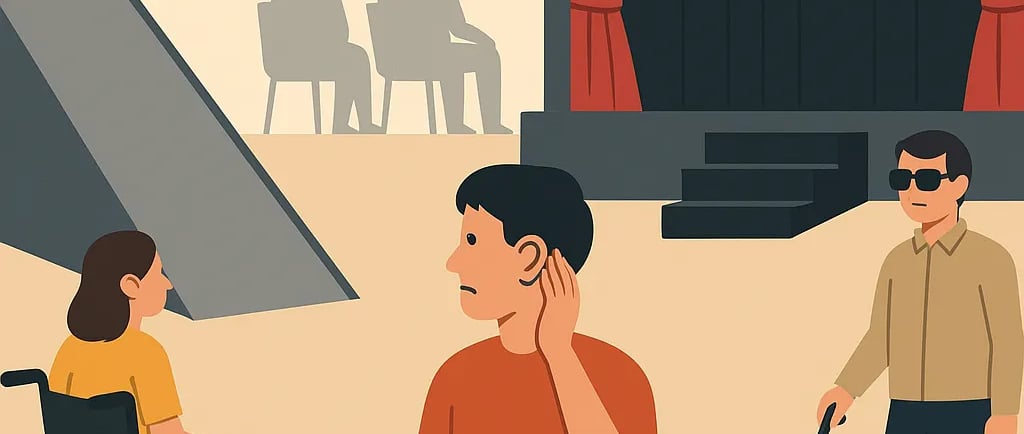
In the last ten days, I’ve attended more disability-sector events than I have in months — conclaves, inclusion summits, NGO–corporate showcases, and one spectacular media-house production. These weren’t mainstream gatherings where accessibility is an afterthought. These were our spaces. Our platforms. Events organised by people who call themselves sector experts, allies, advocates.
Which is why what I witnessed felt far more uncomfortable than usual.
This is not an attack. This is a self-audit. A deeply uncomfortable one.
Because the truth is: the very organisations that spend all year preaching inclusion often replicate the same exclusionary practices they accuse corporates and government bodies of. Sometimes worse, because they do it on stages built for persons with disabilities. Irony has rarely felt this sharp.
The ramp that goes nowhere
The universal symbol of inclusion — the ramp — continues to let us down in spectacular ways.
One venue had a ramp so steep it could have doubled as a Himalayan training incline. Wheelchair users had to be pushed up and down like they were being launched into orbit. At another event, there was no ramp at all; volunteers simply carried wheelchair users onto the stage, limbs and dignity dangling mid-air.
I don’t know who needs to hear this but:
Ramps are not props. Ramps are not symbolic gestures. Ramps are not “nice-to-have”.
Ramps are infrastructure.
And if disability events can’t get that right, we may need to review what exactly we are “expert” in.
Digital Access: Still a VIP luxury
Digital accessibility at disability events continues to be treated like a bonus feature — something you get only if the stars align.
At one event, closed captions were completely absent, leaving Deaf attendees scanning the stage like detectives, piecing together fragments of context. At another, the captions lagged so badly that reading them felt like watching a dubbed movie where the actor’s lips move first and the dialogue arrives sometime next week.
And the sign language interpretation?
Let’s just say entire sentences went missing, tone was lost, and accuracy became a negotiation.
Then came the presentations and AVs — slide decks packed with text, visuals, charts, timelines, metaphors, cosmic imagery… all delivered without verbal description. Blind attendees sat through these sessions like spectators at an audio-free cinema.
If you’re showing a video without audio description at a disability event, what are we even doing?
Accessibility cannot be something we “hope” works. It has to be something we plan.
The sensory assault
This section needs no polite framing, it was brutal.
I’ve recently developed an eye condition that makes adjusting to sharp lights and sudden brightness extremely difficult. But apparently, the lighting director at a major media-led disability event got a brief that said: “Make it look like the Oscars on steroids.”
Lights flashed, changed colours, pulsed like a rave.
LED backdrops glowed like molten lava.
I sat there squinting, blinking, tearing up — and not from emotion.
People with low vision, photophobia, migraines, sensory processing conditions, and neurodivergence struggle in such environments. And yet the production design marched on, prioritising glamour over access, spectacle over comfort.
Invisible Disabilities: The convenient blind spot
We speak passionately about invisible disabilities — from IBS to chronic pain to sensory overload — but our event planning conveniently ignores them.
One event had AC temperatures set to “Siberian winter”. I sat freezing, stomach cramping, body tensing, unable to focus on anything being said. No temperature-neutral zones. No quiet rooms. No low-stim areas.
Invisible disabilities are the easiest to ignore because they don’t scream for attention.
But they exist. And they matter.
The language problem: Pity masquerading as empathy
Perhaps the most ironic failing came from an event hosted by a major media group — yes, the same media that shapes public opinion and claims to champion social awareness. And yet, speech after speech was drenched in ableist language: “special souls,” “brave fighters,” “overcoming despite disability,” “inspiration to us all.” The audience clapped. The mood softened. But the narrative remained stuck in an outdated pity frame.
Why are disability audiences not pushing back? Why are we letting the media get away with emotional packaging instead of respectful representation? If the disability sector cannot correct the narrative in our own spaces, how do we expect mainstream audiences to understand the difference between empathy and condescension?
Language is not cosmetic. It is political.
The barriers between the entry gate and the stage
Accessibility doesn’t start at the stage — it begins outside the venue. Yet across events, I found poorly marked entrances, inaccessible parking areas, decor blocking wheelchair paths, uneven or dimly lit corridors, and toilets labelled “accessible” but designed for acrobats. These aren’t minor glitches; they determine whether attendance feels effortless or exhausting.
Becoming what we critique
What unsettled me most this past few days was the pattern of explanations that followed. The reasons sounded painfully familiar: “The vendor didn’t know,” “It was too expensive,” “We ran out of time,” “The hall didn’t allow modifications.” These are the very excuses disability advocates reject when corporates or governments use them. And yet now, they are coming from within the sector.
We cannot demand accountability outward while practicing convenience inward.
Disability events must not mirror mainstream events with a disability-themed filter.
They must be models of inclusion.
Accessibility needs expertise — not assumptions
One of the easiest, most impactful solutions is also the most underused:
Engage a disability ally/expert who understands both mass media and accessibility.
Someone who can design events that look good and include everyone. Someone who can guide production teams, event managers, AV technicians, volunteers, and speakers.
This is the one of the intersections I work in at Karuneti — where editorial judgment, production understanding, and disability inclusion sensitivity come together. And honestly, this is not a luxury. It is foundational.
So here is my final ask
If disability events continue to exclude disabled people —
from the stage, from the screens, from the content, from the language, from the logistics —
What exactly are we showcasing?
Inclusion, or our own complacency?

Let’s Build Something Inclusive.
info@karuneti.com
© 2025. All rights reserved.
Whether you’re rethinking communication, leadership, or workplace culture, Karuneti helps you design with inclusion at the core.